
Anti-Black racism is a public health crisis
-
newsletter
-
blog post
by
Earlier this month, a coalition of Black health leaders called for “faster action to meaningfully confront white supremacy” and outlined a series of necessary steps, including the recognition of anti-Black racism as a public health crisis.
“Regis Korchinsky-Paquet joins a long list of Black people who have died in police presence, after wellness calls were made for help,” reads the joint statement from the Black Health Committee, the Black Health Alliance, and the Network for Advancement of Black Communities. “We cannot be silent in the face of the ongoing horror Black people are experiencing.”
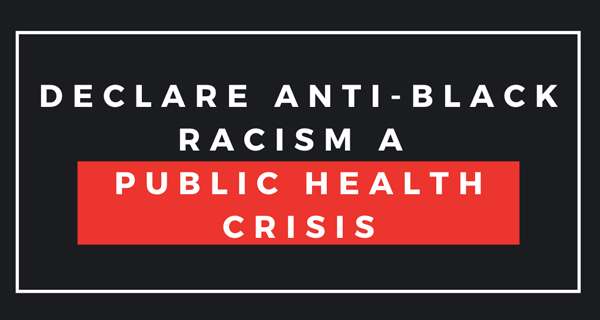
This week, the Toronto Board of Health responded to their call, unanimously voting in favour of recognizing anti-Black racism as a public health crisis. In response, executive director of Toronto’s TAIBU Community Health Centre, Liben Gebremikael, wrote a letter calling for a “10-year strategy and plan to address Anti-Black racism in our public health systems.” Anti-Black racism, Gebremikael wrote, will not be solved by “a few resolutions and actions.”
Public health, decent work, and racial justice are deeply intertwined.
To date, 1,865 workers in long-term-care homes have been infected by COVID-19 and 805 are still away from work sick. At least 7 have died. Across Canada, workers in nursing and long-term care homes are predominantly racialized immigrant, migrant, and refugee women. In the hard-hit Montreal area, up to 80% of aides in long term care are racialized women, mostly Black and Maghrebi.
From low wages to unfair scheduling that forces workers to take multiple jobs, workers in care homes have for a long time been sounding the alarm about poor conditions that put their health at risk. COVID-19 has intensified the crisis, with deadly consequences. This grim reality reflects the systemic disregard for the well-being of the racialized and gendered workforce in long-term care. Addressing racism at work must be at the centre of efforts to rebuild the long-term care system.
Lack of race-based data is anti-Blackness in action
We don’t know all of the ways that COVID-19 has impacted Black, racialized, and Indigenous communities, because despite numerous calls for public health institutions to collect data on race and immigration status, there has yet to be a nationwide or even provincewide policy. “The refusal to collect rigorous race-based health data is anti-Blackness in action,” wrote Bee Quammie yesterday, “it allows governments and gatekeepers the ability to dismiss anecdotal evidence raised by the community, and it allows them to be slow to act.”
OmiSoore Dryden, chairwoman of Black Canadian Studies at Dalhousie University, warned that Canada’s claim to “a colour blind approach has resulted in increased health inequities with, and poorer health outcomes for, black and Indigenous people.”
Others have pointed out the need for this data well beyond COVID-19 because, as Quammie put it, “Racism—the cause of so much illness, anxiety and death—is the pandemic that Black people live under all of our lives.”
Health workers must take ongoing and bold steps to confront systemic racism.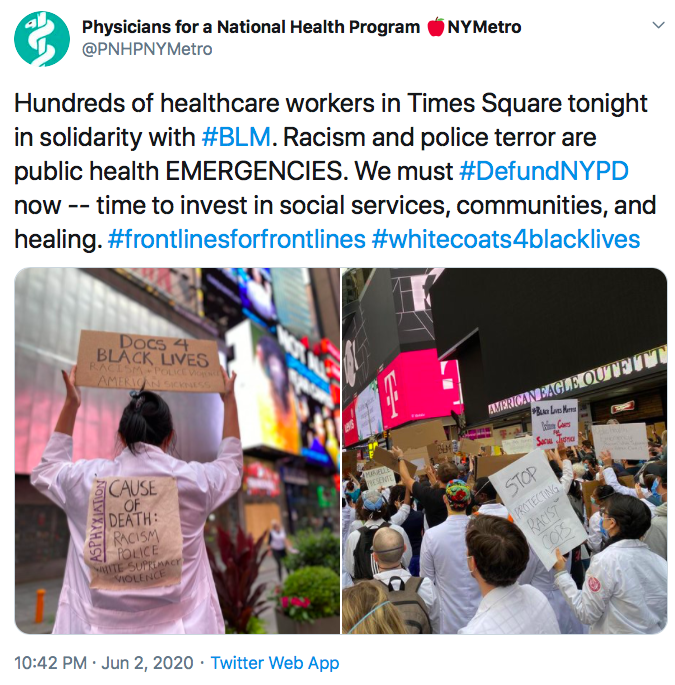
As health workers, it is crucial that we understand how anti-Black racism has been built into the Canadian healthcare system, and that we take steps daily to confront systemic racism and to identify and challenge our own complicity.
“We urge our allies to make commitments to addressing the many iterations of white supremacy and anti-Black racism by standing in solidarity with Black people, committing to interrupting cycles of violence and refusing to make this an issue only Black people care about,” reads the call from Black health leaders. “This is everyone’s business.”
In practice, this means supporting the efforts already underway to address systemic racism and being led by those most impacted, from efforts to increase Black enrollment in medical schools and nurses joining protests across the U.S. to provide aid, to the ongoing advocacy work of Black health leaders and allies to develop research, build public awareness, and demand policy change.
In the U.S., after receiving a wave of requests to comment on how protests endanger the spread of COVID-19, a group of infectious disease specialists drafted an open letter stating clearly that ongoing protests against anti-Black racism and police violence are “vital to the national public health”. Over 1200 U.S. health workers and stakeholders have since signed the letter, stating their support for “protests against systemic racism, which fosters the disproportionate burden of COVID-19 on Black communities and also perpetuates police violence.”
In solidarity,
The Decent Work and Health Network Team
∧ Back to top