
From CRSB to provincial schemes, permanent & employer-paid sick days still missing
From CRSB to provincial schemes, permanent & employer-paid sick days still missing
By Carolina Jimenez RN and Jesse McLaren MD
During the first wave, provincial governments largely refused to discuss paid sick days. During the second wave, they claimed paid sick days already existed in the form of the Canada Recovery Sickness Benefit (CRSB). In the third wave, after months of pressure from health providers, workers, public health officials, mayors and community advocates, some provincial governments have moved to implement paid sick days through programs (or schemes) which are limited in scope and duration.
Starting with Ontario, and now in Nova Scotia, British Columbia and Manitoba, provincial governments have introduced paid sick days for COVID-19. This is unprecedented and an important step in winning the paid sick days our patients deserve. It is proof that organizing works! It shows us that the organizing we do in Ontario can have a ripple effect and impact the lives of workers across Canada.
However, the newly implemented paid sick day schemes are insufficient -- a partial treatment, when we know a full dose is warranted to stop the spread of infection at workplaces during COVID-19 and beyond. All the provincial plans are inadequate and temporary: from 3 to 5 paid sick days provided by the employer and reimbursed by the government, which can only be used for reasons related to COVID-19 and will end before 2022.
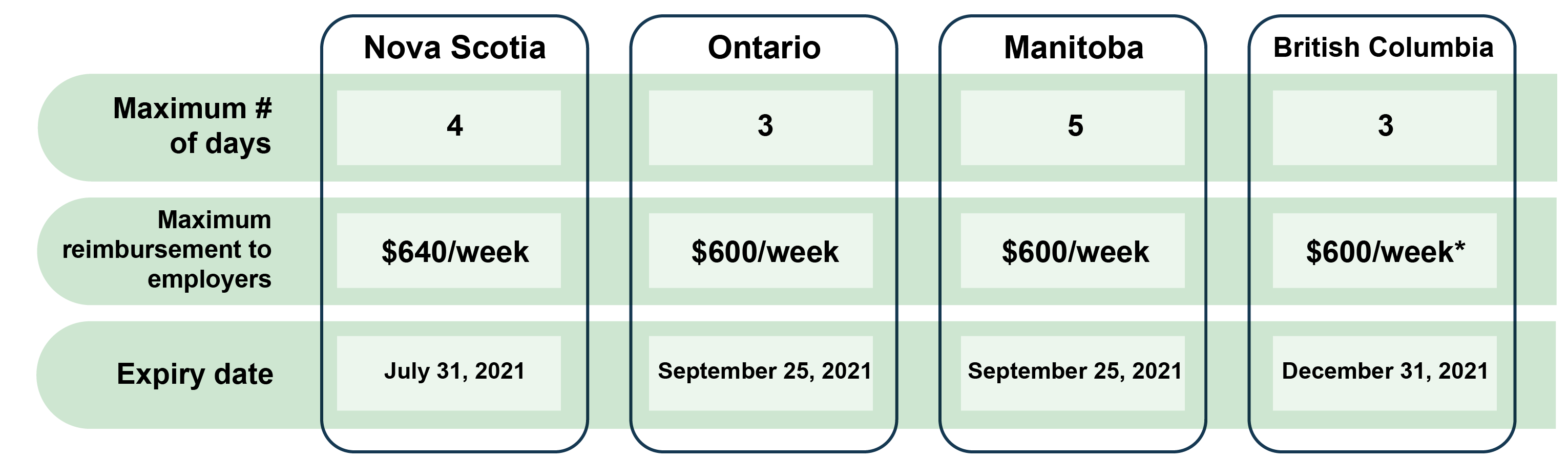 * Employers are reimbursed up to $600 by the BC government, but employers have to pay workers their full wages, even if they exceed $600.
The Decent Work and Health Network report released in August 2020 is clear, paid sick days need to meet five criteria:
- Seamlessly accessible on the first day of symptoms
- Fully-paid because workers shouldn’t be punished for staying home when sick
- Adequate for a one day vaccine or two-week quarantine
- Universal for all workers, because no one is protected until everyone is protected
- Permanent because we need to protect public health during and beyond the pandemic
The federally mandated CRSB failed every criteria: workers have to miss at least half a week of work before applying, they would receive retroactive payment resulting in a pay cut, which they can’t use for one day of COVID testing or vaccination, and which is temporary and not available to workers without a social insurance number. In February a survey of over 8,700 frontline healthcare workers confirmed that the lack of paid sick days was a major barrier to vaccination with two-thirds of respondents indicating that they would be more likely to get vaccinated if they had paid sick days.
All of the provincial paid sick day schemes address some aspects of seamless accessibility because they are employer-provided and paid on a workers next pay cheque. Finally, after a year of a deadly pandemic, low-wage workers can take a day off work for a COVID test or to get COVID vaccine without losing an entire day’s pay, which will help workers access the vaccine and curb the spread of COVID-19. These paid sick days will save lives, and would not have happened without a sustained movement organizing for paid sick days. Even Premier Ford, who cut two paid sick days before the pandemic, has been forced to reverse course and provide three paid sick days during the pandemic.
Unfortunately, these new provincial programs still leave workers navigating multiple benefits, which is complicated and stressful for workers who are likely already sick. Workers are not able to access the provincial paid sick day schemes and CRSB in the same week. This means if a low-wage worker ends up needing to take the whole week off, they could end up worse off taking provincial paid sick days than if they had applied for CRSB to begin with. For example, in Ontario, a worker making $14.25 per hour accessing 3 provincial days would get less than $300 per week, but would be entitled to CRSB at $500 that week. If an Ontario worker decides they want to access CRSB for that week instead, they would have to opt out of the provincial paid sick days program in writing before the end of the pay period.
These new provincial paid sick day policies also fail every other criteria:
- They are not fully-paid by employers, because not all workers are guaranteed their full wages (except in BC) and they are government subsidized through a reimbursement, which rewards employers like Amazon and Loblaws that deny paid sick days in order to maximize profits
- They are not adequate in number, because 3-5 days doesn’t cover a two week quarantine
- They are not universal, for example in Ontario they exclude independent contractors
- They are not permanent, with programs set to expire in July or September, right before flu season (except in BC where number of permanent days that come in to effect on January 1, 2022 is yet to be determined)
Provincial governments must not allow paid sick days to expire. In Ontario, if the province allows paid sick days to expire in September, it will be the second time the current government cuts paid sick days from low-wage and predominantly racialized workers. While mass vaccination will help curb COVID-19 cases, the pandemic has created a huge backlog in surgeries and cancelled clinics for chronic illness, and taken a major mental health toll. Paid sick days are essential for post-pandemic recovery.
Neither the need nor the demand for paid sick days is over. Modeled on the campaign criteria and mirroring similar legislation introduced by MPP Peggy Sattler in Ontario, the Saskatchewan NDP has introduced Bill 603, The Saskatchewan Employment (Paid Sick Leave) Amendment Act, 2021. If passed, it would provide 10 permanent and employer-paid sick days, plus 14 days during a pandemic. The government of British Columbia has also legislated permanent paid sick days starting next year -- with the number of days set to be determined in consultations this summer.
Over the past year our movement has pushed governments across the country to provide temporary paid sick days, including pushing Premier Ford to reverse course and promise “the best paid sick days in North America.” But permanent and employer-paid sick days are still denied to 58% of workers across Canada, and this rises to three-quarter of low-wage workers -- who are disproportionately migrant and racialized. We know all too well that COVID-19 has exposed the deadly and inequitable consequences of inadequate paid sick days. That is why we must build on the momentum of recent months to push all governments to provide 10 permanent and employer-paid sick days for all.
|
How do current paid sick days stack up against our principles? |
|||
|
CRSB |
New provincial paid sick day schemes |
Effective paid sick days |
|
|
Seamlessly accessible |
X Have to miss half a week then apply and wait |
✓Employer-provided, no application, paid on next paycheque X Sick workers have to navigate interaction with CRSB |
✓ Seamlessly accessible |
|
Fully paid by the employer |
X Federal government subsidy, capped at $1000/week |
X Not fully paid for all workers, except in BC X Government reimburses employers (up to $600-640/week) |
✓ Fully paid by the employer |
|
Adequate |
X Can’t be used for one day vaccine |
X 3-5 days not adequate |
✓ 10 + 14 during pandemic |
|
Universal |
X Not universal |
X Not universal |
✓ Universal |
|
Permanent |
X Temporary |
X Temporary, except BC with number of permanent days still to be determined |
✓ Permanent |
Learn more about the temporary provincial paid sick days in Ontario in a fact sheet from the Workers’ Action Centre, available here.